
Pricing
Bee Removal Cost
What sets the price of every service we offer, what each price covers, and why we inspect before quoting.
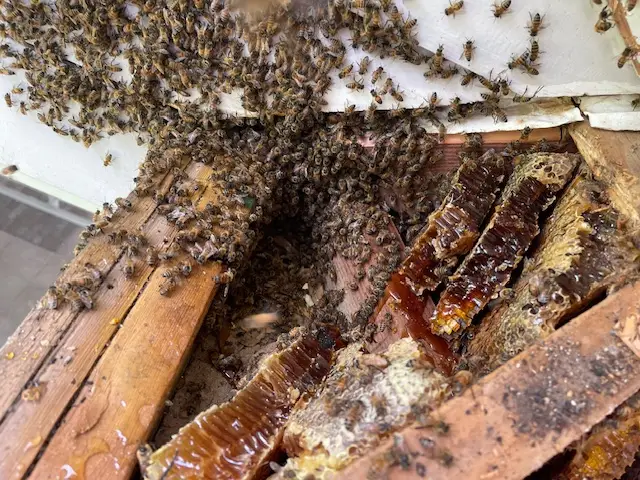
The price of bee removal depends on the situation, not a fixed list. Every job is priced after a free inspection, because the colony location, the species and the structure change what the work involves.
How is each service priced?
Each service is priced after a free on-site inspection. The table below shows what each price covers, so you know what the work includes before you book.
| Service | What the price covers |
|---|---|
| Swarm relocation | A cluster in the open. No structure opened. |
| Exterior bee hive | Accessible hive on a branch, fence or wall face. |
| Structural hive (wall, attic, soffit) | Cavity opened, comb cut out, structure rebuilt. |
| Wasp nest, exposed | Paper wasp comb under an eave or fence. |
| Wasp nest, in a cavity | Nest inside a wall, soffit or attic. |
| Yellow jacket nest | Ground or cavity nest, located before treatment. |
| Mud dauber nests | Priced per visit on nest count and access. |
| Carpenter bee treatment | Galleries treated and sealed, with timber protection where chosen. |
| Bumble bee nest | Relocated where the nest location allows. |
| Bee & Wasps Prevention Service | Full structural treatment, in four service options. |
| Inspection | Always free, and before any price is agreed. |
What moves the price of a job?
Six factors set the price of a job. Location in the structure moves a pricefurther than anything else on the list.
- Location in the structure. An exterior nest needs no carpentry. A colony inside a wall or attic means opening the cavity and rebuilding it, which is the single largest cost difference.
- Species. Honey bees are relocated to a beekeeper, which adds handling and transport. Wasps are treated and removed. Carpenter bees need the timber sealed afterwards.
- Colony size and age. Comb volume grows every week. An older colony means more comb to cut out, more honey to clean up and more cavity to repair.
- Access. Ground-level work costs less than roofline or second-storey work, which needs ladders, fall protection and more time.
- Repair scope. Brick, stucco and slate cost more to open and reinstate than lap siding or drywall.
- Urgency. Same-day attendance carries a premium. A nest beside a doorway or play area usually justifies it.
Why does waiting increase the cost?
Waiting increases the cost because a colony builds comb continuously. Every additional week adds comb to cut out, honey to clean up and cavity to repair, which turns an exterior job into a structural one.
A swarm caught on a branch is the simplest job. The same colony three weeks later, established inside a soffit, takes far more work. Booking early is the single largest saving available on this page.
Pricing questions
What else do people ask about bee removal cost?
The price of bee removal depends on the situation. Location in the structure sets most of it, and species, colony size, access, repair scope and urgency set the rest. The inspection is free and the price is confirmed in writing before work starts.
Every infestation is different, so a fixed figure would mislead. The price depends on the species, where the colony sits, how large it is and how the structure is built. The free inspection gives you the written price before any work starts.
Location drives the price more than colony size, and location cannot be assessed remotely. A phone figure is a guess that changes on arrival. We inspect first, at no charge, then quote.
Yes. Opening the cavity and closing it again are both part of a structural removal. Siding, soffit, drywall or roofing goes back as it came off, and you receive photographs of each stage.
A spray costs less on the day and more afterwards. It leaves the comb, the honey and the pheromone trail inside the cavity, which causes leaking, secondary pests and reoccupation by the next swarm.
The repair bill from a wall left full of comb routinely exceeds the removal it avoided.
No. The inspection costs nothing, including the thermal imaging used to locate a colony inside a cavity. One customer review contrasts that directly with competitors who quoted before looking at the job.
The agreed figure is confirmed in writing before work begins, and it does not change unless you approve additional work first. Ask about the current guarantee terms when you book.
Free estimate
How do you book a removal?
You book a removal in one step. Send us the species, the location and a photo, and we arrange a free inspection. The on-site inspection costs nothing, and the price is confirmed in writing before any work starts.